Validation
Generated by python scripts/validation_report.py --write; a test fails
when this page and a fresh run disagree.
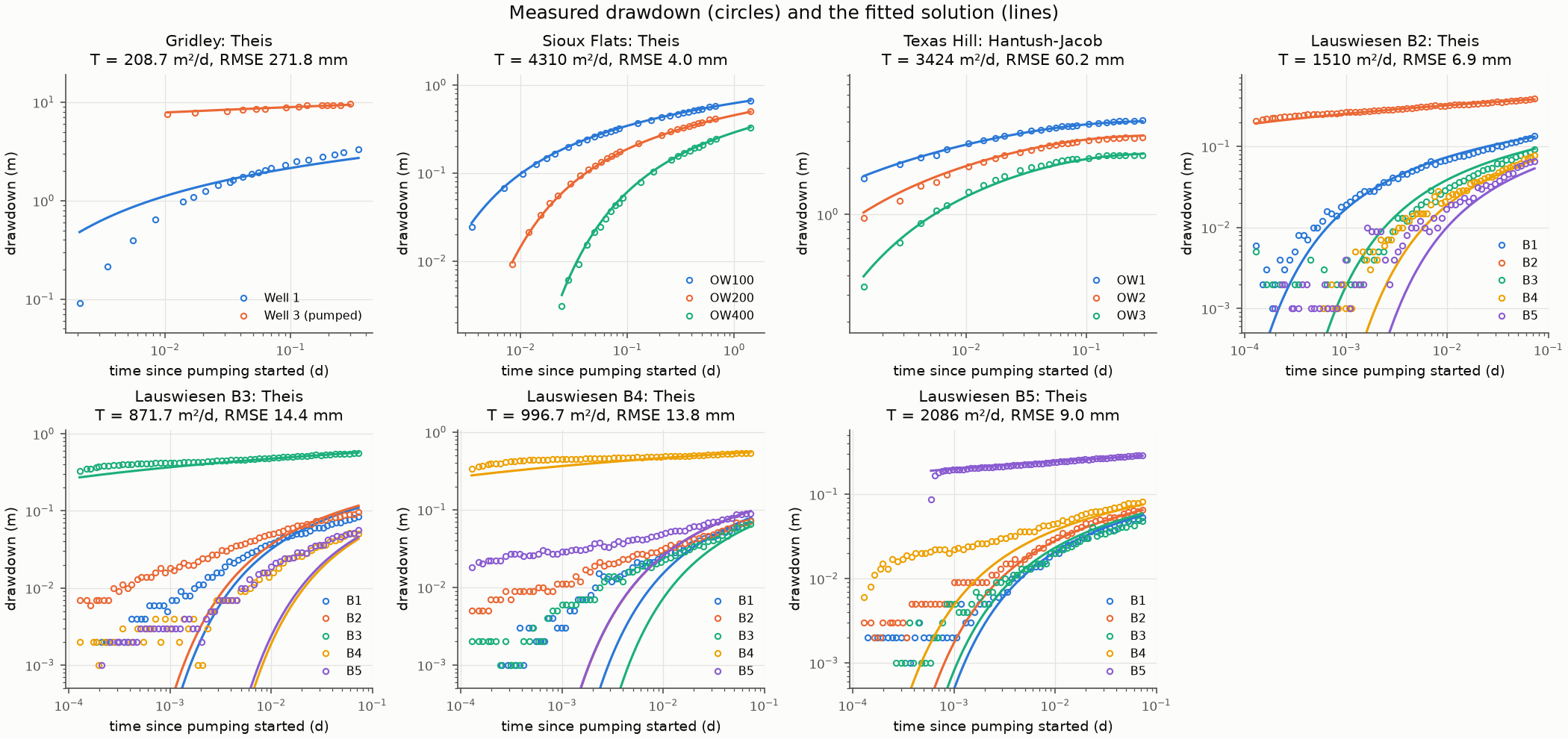
Against AQTESOLV
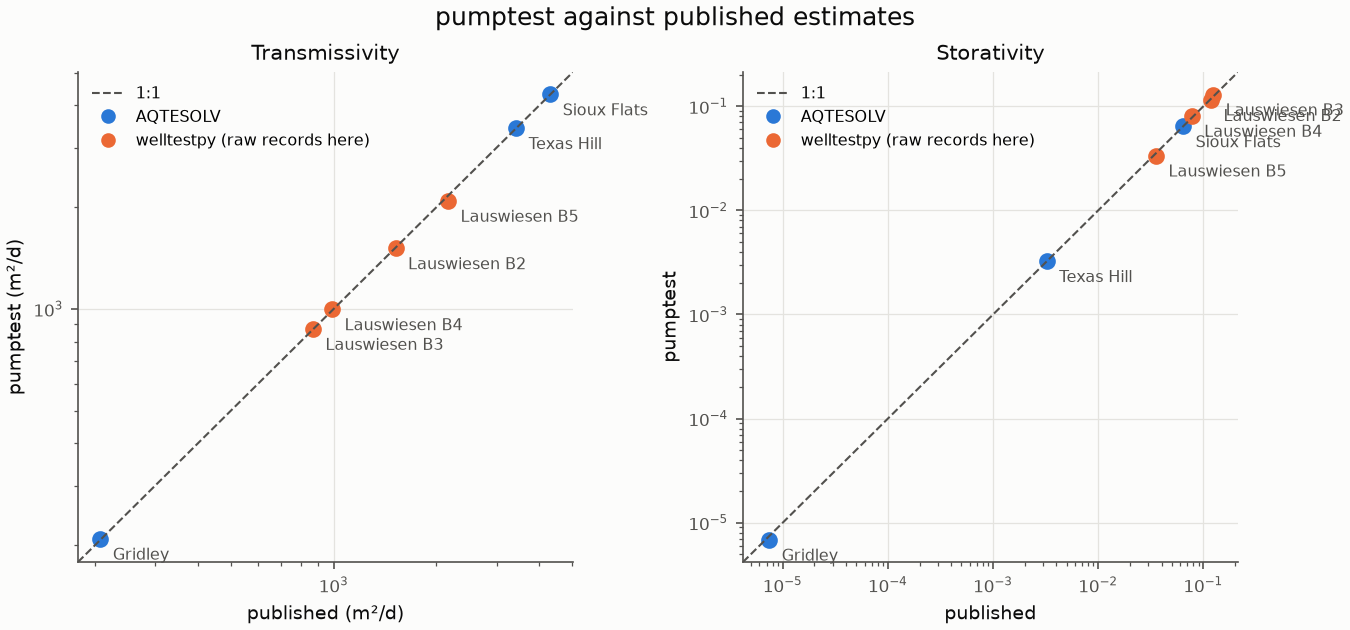
Three tests from the AQTESOLV manual (Duffield, 2007), fitted here and compared with the AQTESOLV parameters reported by Yang (2020). T is in square metres per day, c (aquitard resistance) in days. Both RMSE columns are computed here, on the same data, in metres: the published parameters' fit and ours.
| Test | Model | T published | T here | S published | S here | c published | c here | RMSE published | RMSE here |
|---|---|---|---|---|---|---|---|---|---|
| Gridley | Theis | 207.3 | 208.7 | 7.437e-06 | 6.836e-06 | 0.273 | 0.2718 | ||
| Sioux Flats | Theis | 4308 | 4310 | 0.06418 | 0.06414 | 0.003974 | 0.003974 | ||
| Texas Hill | Hantush-Jacob | 3425 | 3424 | 0.003239 | 0.00325 | 43.96 | 43.89 | 0.06025 | 0.06024 |
Data: the TTim documentation (MIT); published values: Yang (2020), as
tabulated in the TTim notebooks. Provenance is in
src/pumptest/datasets/data/README.md.
Against welltestpy
Four open pumping tests at the Lauswiesen research site (Leven, 2020), compared with the Theis estimates that Mueller et al. (2022) obtained with welltestpy. welltestpy fits a smoothed record sampled at ten times per well; the columns 'their points' fit exactly those points, the columns 'raw' fit every reading. RMSE is on the raw records, in metres.
| Test | T welltestpy | T their points | T raw | S welltestpy | S their points | S raw | RMSE welltestpy | RMSE raw |
|---|---|---|---|---|---|---|---|---|
| Lauswiesen B2 | 1518 | 1518 | 1510 | 0.1181 | 0.1182 | 0.1145 | 0.006995 | 0.006853 |
| Lauswiesen B3 | 869.2 | 869.2 | 871.7 | 0.124 | 0.124 | 0.1298 | 0.01451 | 0.01436 |
| Lauswiesen B4 | 989.1 | 989.1 | 996.7 | 0.07743 | 0.07743 | 0.08084 | 0.01407 | 0.01378 |
| Lauswiesen B5 | 2162 | 2162 | 2086 | 0.0354 | 0.0354 | 0.03357 | 0.01011 | 0.008956 |
Well functions against independent evaluations
The leaky, large-diameter and unconfined solutions are computed in the
Laplace domain and inverted numerically. Each is compared with the same
published solution evaluated another way: the Hantush integral by direct
quadrature, and the real-time integrals of Papadopulos and Cooper (1967)
and Neuman (1975) by scripts/reference_values.py. Every value agrees
within a relative 1e-04, the tolerance of the test. Theis
is checked against the exponential integral summed from its power series
in 60-digit decimal arithmetic. Neuman's solution also reduces to Theis
with S when Sy is zero and with S + Sy at late time.
See tests/test_type_curves.py.